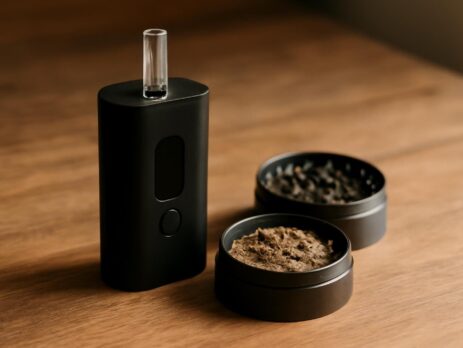
Choosing a dry herb vaporizer: what to look for in your first device?
You choose a dry herb vaporizer based on four things: how hot it gets and how precisely you can adjust that, how it heats (conduction or convection), how long the battery lasts, and how easy it is to clean. Anyone who has these four points in mind finds buying a dry herb vaporizer much easier than someone who only looks at the price or the color.
A dry herb vaporizer heats dried herb until it is released as vapor, without the herb burning. That is the difference compared to smoking: burning produces smoke, whereas vaporizing keeps the herb below its combustion point. The temperature used for this determines much of the flavor and vapor thickness. The range of dry herb vaporizers is large enough that you can easily get lost without fixed criteria.
Conduction or convection: how does your dry herb vaporizer heat up?
With conduction, the herb comes into direct contact with the hot wall of the chamber. This works quickly, and the devices are usually compact and affordable. The disadvantage is that the herb heats up at the edges sooner than in the center, so you must grind and distribute it well to vaporize evenly.
With convection, hot air flows through the herb. The heating is more even, the flavor is often purer, and you get more out of your herb. On the other hand, convection devices take longer to heat up and generally cost more. Many devices combine both methods, also known as hybrid.
Conduction versus convection
| Conduction | Convection | |
|---|---|---|
| Heating | Herb touches hot wall | Hot air flows through herbs |
| Warm-up time | Usually faster | Usually slower |
| Uniformity | Grind the herbs well and distribute. | More even heating |
| Price | Usually more affordable | Usually more expensive |
Setting the temperature: why it matters
A device with a fixed setting forces you to accept one temperature. With an adjustable temperature, you can switch between light, flavorful vapor and thicker vapor. For a first vaporizer, a device with digital temperature control is therefore a sensible choice: you quickly learn what you like and you don't have to guess.
It is a trade-off. The lower your temperature, the lighter the vapor and the more flavor you taste. The higher you go, the thicker the vapor, but also the closer you get to the combustion point and the faster the herb darkens. So start on the low side and only turn it up if you want more vapor.
Battery, charging time and size
A portable vaporizer is only useful if the battery lasts a session or two. Don't just look at the capacity, but also at how quickly the device heats up and whether you can charge via USB. In practice, you will use a device that takes five minutes to heat up and runs out of battery after every session less than a model that finishes quickly.
Also consider size and weight. A pocket model fits in your jacket pocket but often has a smaller chamber. A larger device or a desktop model produces more vapor but is less discreet. Choose based on where you primarily use it: at home or on the go.
Maintenance and cleaning
Every vaporizer becomes contaminated with herb residue over time. A device with a chamber and mouthpiece that you can easily disassemble is easy to keep clean. A dirty device produces a bitter taste and heats less evenly. Cleaning with isopropyl alcohol and a brush is common practice, and most devices work like new afterward.
Also check if replacement parts are available, such as screens and mouthpieces. These wear out, and a device without spare parts will be written off faster.
Which choice suits you?
If you want to start cheaply and, above all, get started quickly, a conduction heater with temperature control is a logical starting point. If you value taste and even heating, a convection or hybrid model is worth it. If you are looking for an overview of popular models, check out our top 10 vaporizersIf you are unsure between models, you can via the helpdesk or in the store receive advice.
Don't forget the rest of your set. A good one new grinder ensures that your herb is evenly ground, and that makes a big difference, especially for conduction. Orders are packaged and shipped discreetly, even when ordering online. Please note: our site is for those 18 years and older only.
Checklist for your first dry herb vaporizer
- Adjustable temperature
- Conduction, convection, or hybrid chosen
- Battery and warm-up time suit usage
- Chamber and mouthpiece easy to disassemble
- Spare parts available
- Includes grinder for even seasoning
Frequently asked questions
What is the difference between a dry herb vaporizer and a concentrate vaporizer?
A dry herb vaporizer is designed for dried herbs that you place in a chamber. A concentrate vaporizer is intended for wax, oil, and other concentrates. They have different heating mechanisms, so you do not use them interchangeably.
How fine should I grind my herb for a vaporizer?
Medium-fine is usually best. Herb that is too coarse is heated unevenly, while herb that is too fine can restrict airflow. A grinder gives you the most control over this.
Is a dry herb vaporizer the same as an e-cigarette?
No. An e-cigarette works with liquid, a dry herb vaporizer with dried herb. The principle of heating without burning is similar, but the devices and their use differ.